




This essay draws on Zero Ideas’ latest research paper, How AI will reshape the political opportunity for climate. Both that paper and this essay are collaborations with Mariia Shakh, a practitioner in the corporate implementation and governance of artificial intelligence and a senior director for AI transformation at one of Europe’s biggest banking and tech groups.
Artificial Intelligence stands to shape our politics in many ways. It may amplify issues that are already salient: concern about jobs, inequality, power (in both senses), energy prices, local planning. Its bots may disrupt the democratic process itself. These threats are real, well recognized, and much discussed.
More positively, perhaps we will each be ‘individually empowered’, in Mark Zuckerberg’s vision.1 But even without such a rosy view of what AI may bring, it is AI’s threats that will bring an urgently needed change to what is politically doable. Here’s why and how.
The biggest challenges we face in the world today are systemic. Climate change is the most prominent example. Both the risks we face and the responses required operate at the scale of economies, institutions and societies. But despite decades of trying, we have not made those systemic issues sufficiently or consistently politically salient. Political salience sits in the practical here and now, in the household, dominated in the UK, U.S. and elsewhere by the cost of living.
The structural shift in global geopolitics is another systemic challenge that our here-and-now politics isn’t connecting with. People can feel the gap. That feeling is breeding disillusionment with politics, but doesn’t help to close it.
Artificial Intelligence is clearly another big, systemic challenge. The difference, we argue, is that AI has what it takes to close the gap. AI has what climate and geopolitics have lacked. People experience it directly in their lives, while also asking the big questions about power, governance and purpose. Its mix of speed, scale and immediacy provides the paths we have been missing from personal experience to societal concern, as the past month’s discourse has demonstrated.
If concern about AI makes the big, systemic issues salient, that can open up the territory for climate change and geopolitics too. The significance of AI is not just in its own effects on society; it is also in how it may expand how we think politically about the future.
The key question is how to bring political discourse from the immediate issues in my life to the systemic issues shaping society. Figure 1 maps out the territories for what can be politically salient. As well as the distinction between my life and society, it also contrasts concern about what works with concern about matters, in terms of values and meaning.
Figure 1. Schematic ‘salience map’
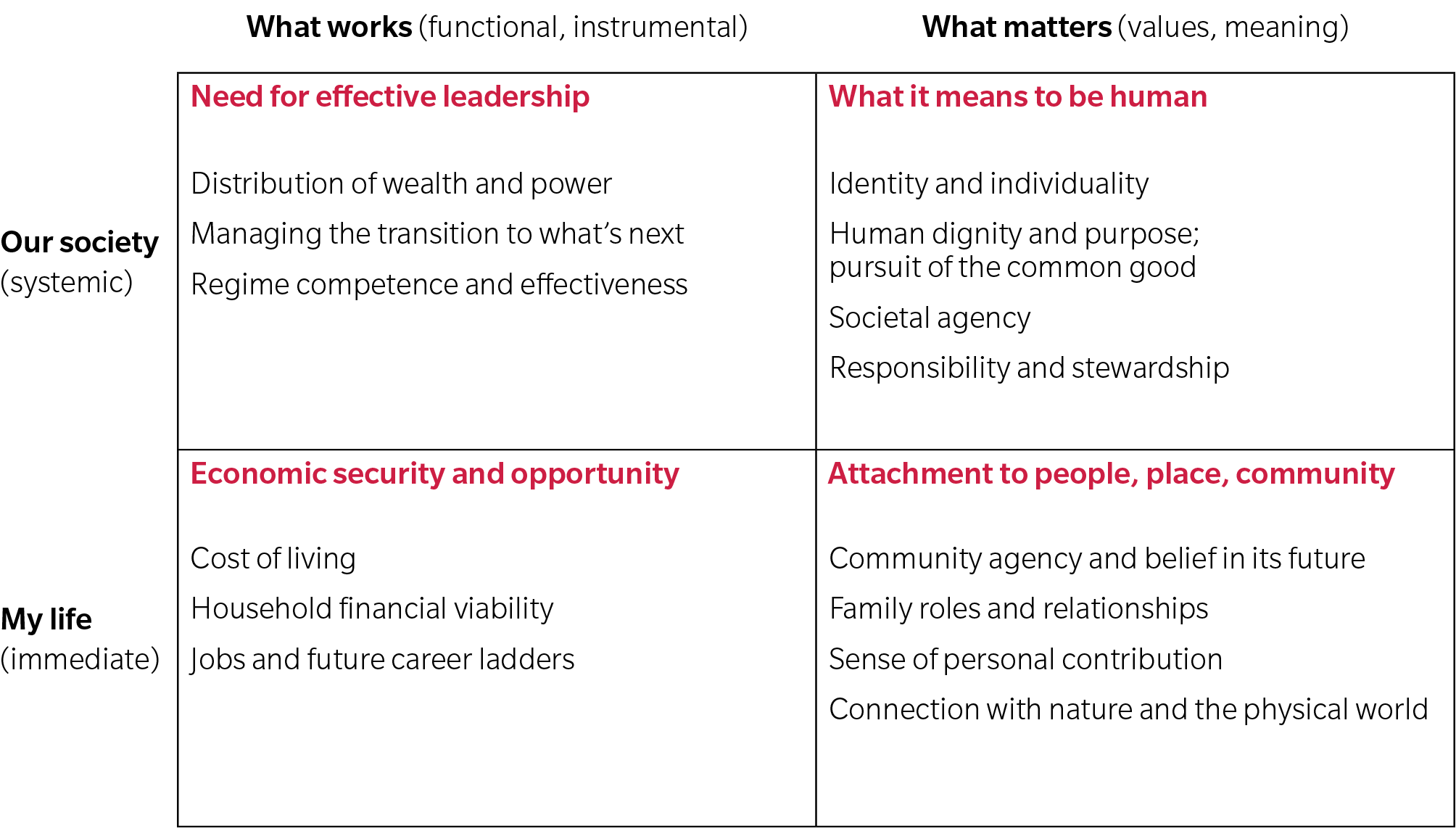
The default territory for political salience is in the bottom left: economic security and opportunity. This is what President Clinton’s campaign strategist meant when he said, ‘It’s the economy, stupid.’
Staying within my life and household, more personal and ‘softer’ issues can also become salient: the attachment to people, place, and community in the bottom right. This territory is concerned with belonging and meaning. It includes the connections I feel to friends and family, to where I live and the community (or communities) I am a part of, and to nature and the physical world.
Moving up to the societal level, the need for effective leadership in the top left is concerned with what is stopping the system working for people. It includes the distribution of wealth and power, how we manage the transition to whatever is next, and questions about the competence and effectiveness of the system of governance.
And finally in the top right, what it means to be human is concerned with the big questions of who we are and what we are here for: our identity and individuality; human dignity and purpose; the pursuit of the common good; and the agency and responsibility of society at large.
While the cost of living may be dominating politics today, this is not fixed. In our research paper2 we show that since the Second World War the UK, U.S., Germany and France have each had important national elections fought in every one of the four territories of the map in Figure 1. And what we see from those examples is not just that salience happens everywhere, but that it usually (though not always) follows from brokenness or loss:
Attachment to people, place, community typically becomes salient after the accumulation of a personal sense of loss, occasionally acutely but more often chronically, building up over time and eroding social cohesion. As an example, the U.S. electing Donald Trump in 2016: the political recognition of a social loss (arising from an economic one) built up over time.
Need for effective leadership typically becomes salient when confidence in an institution is lost, whether because of demonstrable failure, misbehaviour, or a step change in the challenge. As an example, the UK electing Margaret Thatcher in 1979: responding to a sense of ungovernability after the Winter of Discontent, strikes, inflation, tax, and the growing exercise of union power.
What it means to be human typically becomes salient when confidence in ourselves is lost, and also when a belief in ourselves can compensate for losses elsewhere. As an example, the U.S. in 1960, after the success of Sputnik challenged U.S. competence and leadership, setting the stage for the space race.
So far we have established that making systemic, societal issues politically salient is a realistic and achievable idea. But there are good reasons why it often doesn’t happen.
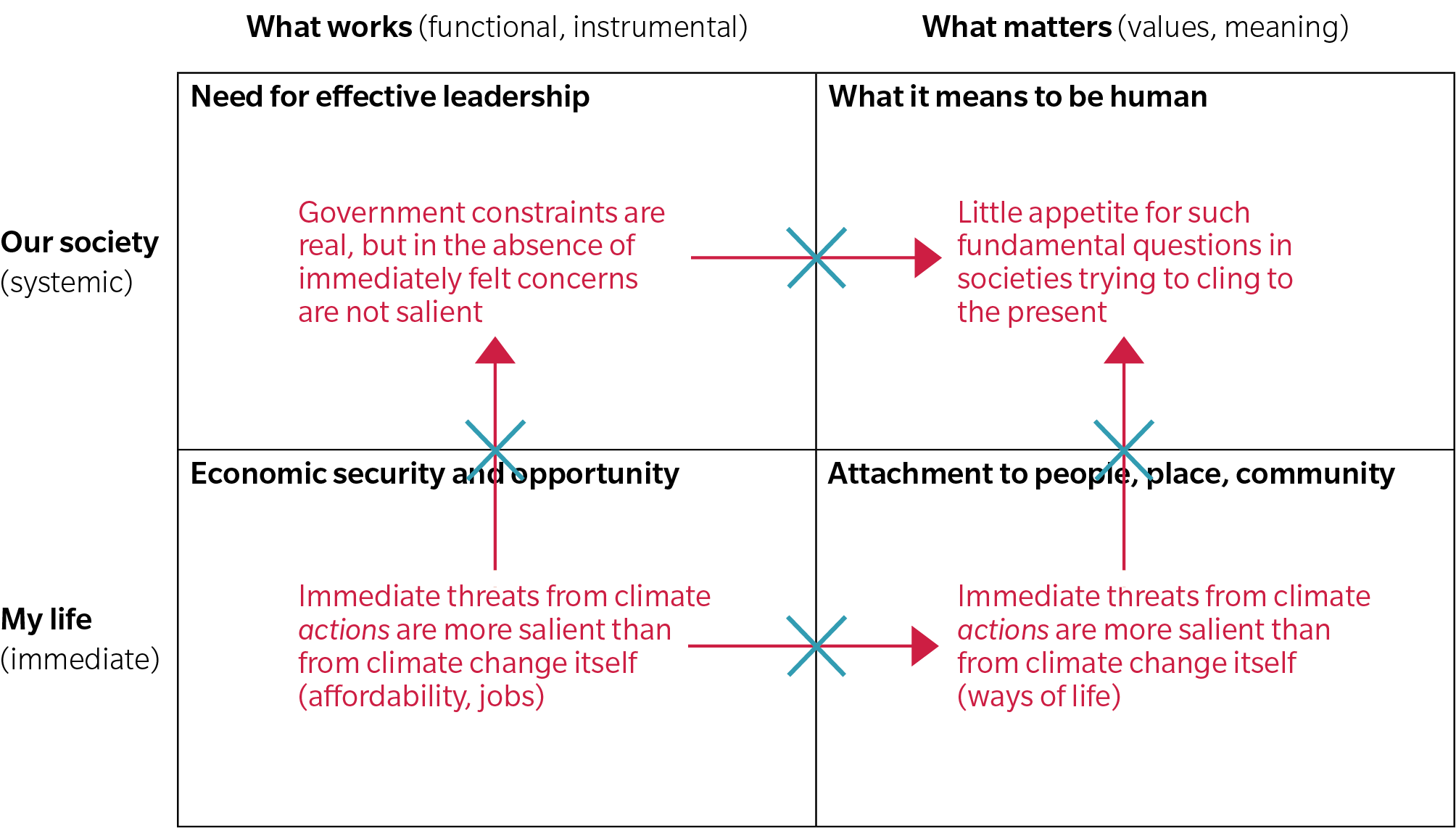
Climate change has failed to move up the salience map because most people in rich countries still experience it abstractly, while they worry about experiencing the interventions to address it concretely. The most serious effects of climate change remain a probabilistic future risk, mostly affecting future generations and often people in other countries; whereas avoiding those effects is seen to impose costs and constraints on me and my family, here and now.
Both in the functional concerns about costs and jobs, and in the value-based concerns about ways of life, the immediate threats from climate actions are often more salient than the worst threats from climate change itself. And as Figure 2 shows, without more of an immediate sense of loss in the immediate (lower) half of the salience map, there is a weak foundation for growing salience in the systemic (upper) half.
Figure 2. Climate change’s struggle for salience
In geopolitics, neoliberalism illustrates how a political theme can migrate across and up the map, from immediate to systemic—but also how slow the migration can be (Figure 3).
Figure 3. The evolving salience of neoliberalism
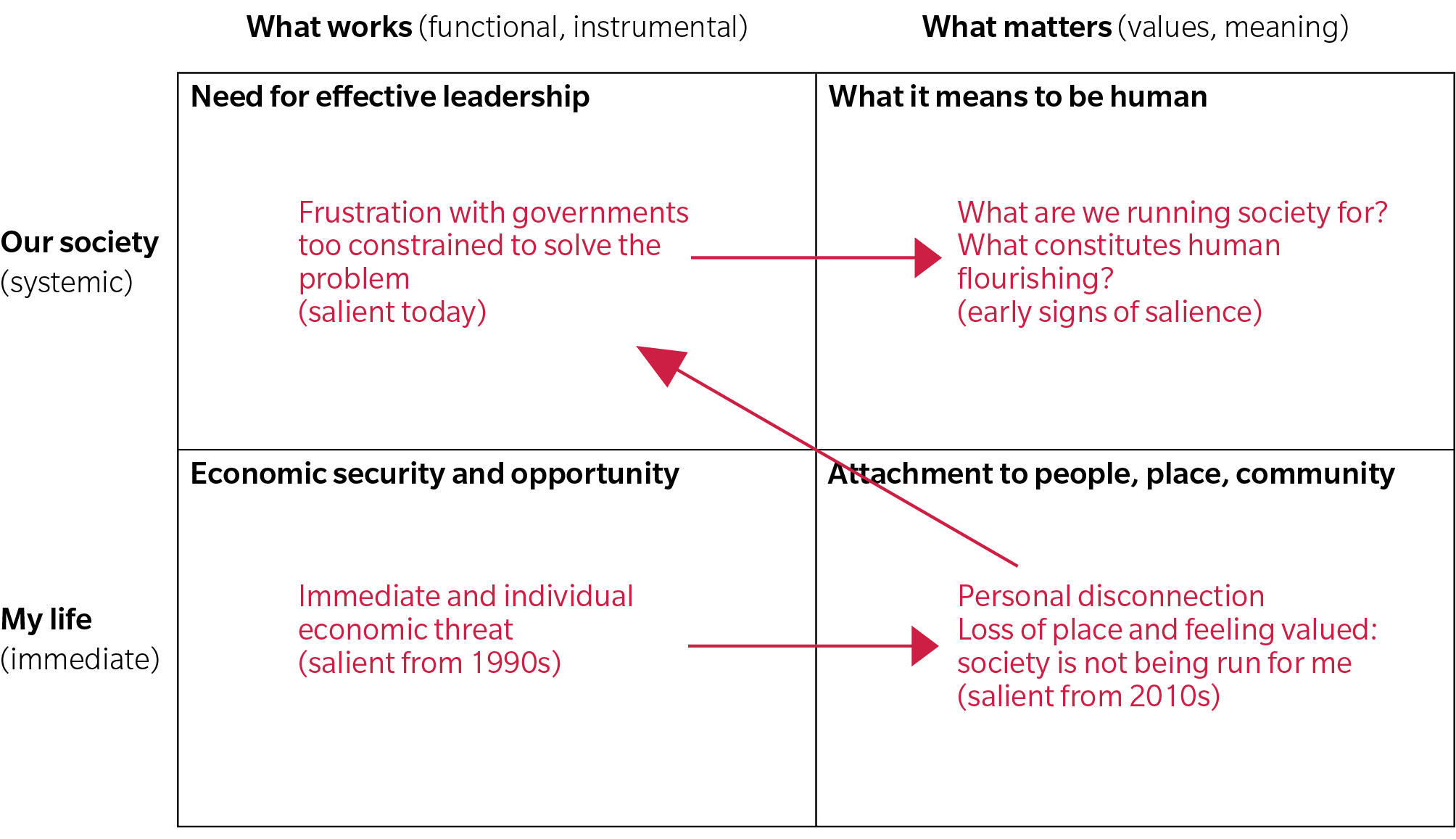
Workers in rich countries have experienced global competition, offshored jobs, and stagnating wages since the 1980s.3 Their economic security has been politically salient since then. But until the 2008 Global Financial Crisis, economic growth and abundant consumer credit helped contain the political consequences. Only since the crisis have the underlying issues become politically salient in terms of people’s attachment to people, place, and community, reflected in the rise of nationalist-populist parties and movements in the U.S., UK, Germany, France, and elsewhere.
What makes the issues systemic is that the sense of personal disconnection has now evolved beyond an immediate, personal issue, into a sense that society is not being run for me or people like me.
This is more than a frustration with individual leaders, governments, or policies. G7 governments find themselves unable to respond effectively, because they can’t reconcile the expectations of their people with what is needed to keep their economies competitive in the global markets they helped to create. The social contracts they had made with their people during the Cold War, justified by the ideological competition from Communism and protected by borders, have proved unaffordable in an era of globalism.
As it becomes clear that this structural challenge can’t be solved by a change of government, people start to question who and what we are running society for. This is not (yet) at the level of what it means to be human, but there are signs that we are no longer only in the territory of what works, but increasingly of the bigger questions of what matters.
The journey across the map is still incomplete after more than 40 years.
Climate change hasn’t moved up the map. Neoliberalism has crept up slowly over a generation. But the dynamics of AI are different from both. What’s significant about AI in this context is not that it is also a systemic issue, but that it provides the paths from the immediate to the systemic that climate change and neoliberalism have failed to achieve.
People’s experience of AI is far from abstract. We are already reaching the point where most people in developed countries use generative AI directly, whether at work, home, or both. And those that don’t use it themselves experience it almost as directly in search results or customer service. It’s already a factor in individual career choices, even if the impacts are unknown.
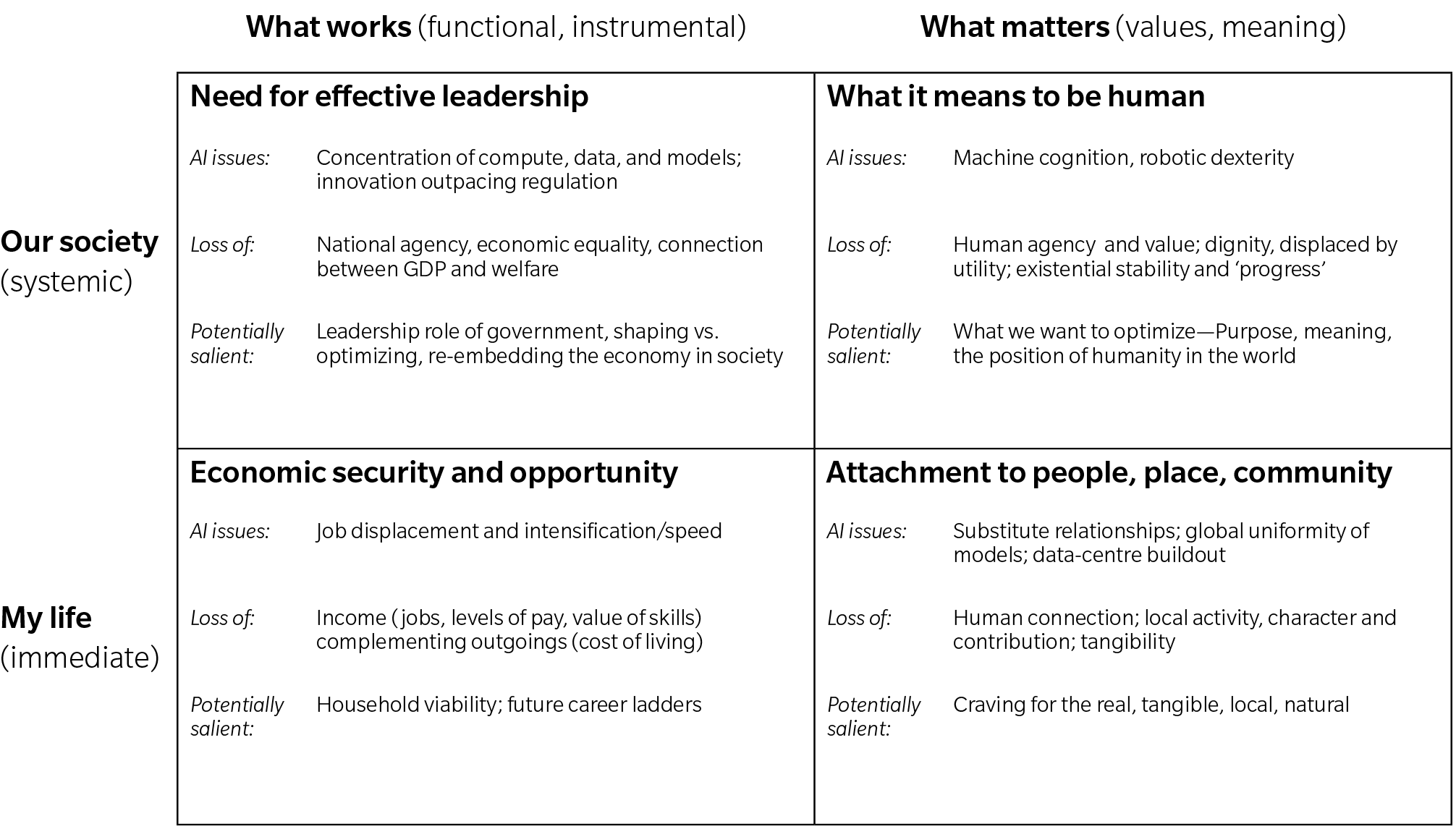
The observation that salience usually follows from brokenness or loss is significant, because AI is positioned to drive various forms of loss in every territory on the salience map. Figure 4 summarizes the picture; our research paper cited earlier describes the details. The important point here is that, with all these losses being felt at once (whether as fear or as reality), there are multiple, direct paths from these immediate experiences to the salience of systemic, societal concerns. That is obviously not a desirable state, but the cloud may have a silver lining.
Figure 4. Potential salience-driving losses that may result from AI
Already today, opposition to the build-out of AI data centres has become a political issue in the U.S. midterm elections. The concern driving that opposition is not just about electricity water use. To quote a recent Brookings commentary, ‘AI has become an existential threat for many individuals, and data centres have become the means for people to express their worries about overall AI development. It is hard to fight AI rollouts, which are largely controlled by tech firms, but easy to gin up community opposition to data centres because they require local permits and environmental safeguards.’4
The functional, immediate concerns about job losses, career prospects and the future value of skills are already culturally salient. They are not yet established as electoral priorities, but they have several characteristics—personal exposure, potential loss and identifiable concentrations of power—that could make them so.
From there, what is remarkable about AI is that salience appears already to be spreading in all directions at once (Figure 5).
Figure 5. AI’s paths to systemic salience
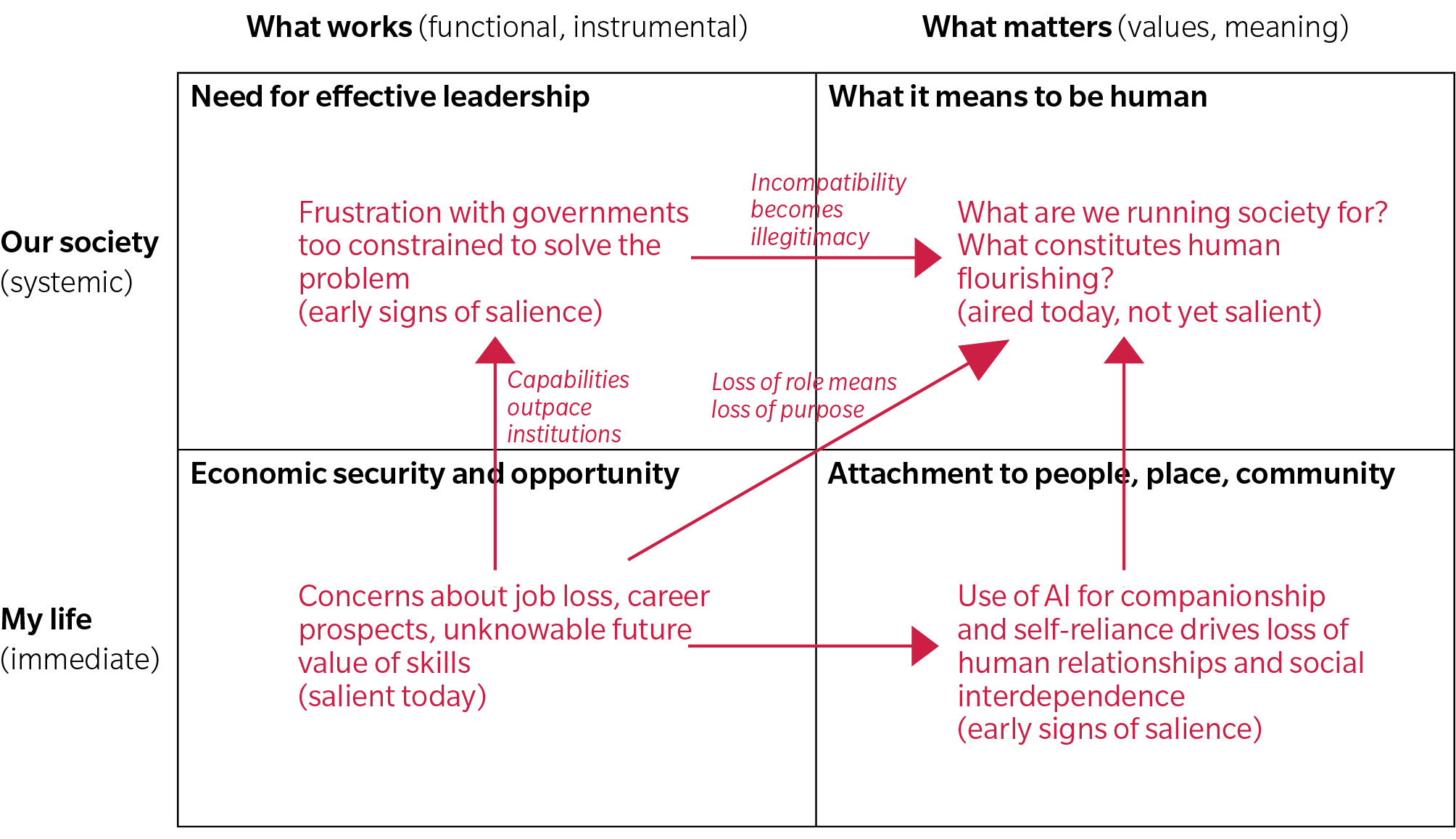
On the functional (left) side of the map, the gap between how fast AI capabilities are growing and the sluggish capabilities of our institutions to respond is both vast and visible. There are increasingly noticeable signs that governments, business, and even the AI frontier labs themselves, are not in control. Leaders’ fear of missing out has been overriding people’s other important fears, as well as more purposeful ambitions. This comes at a time when populations are already questioning whether their governments are complicit in what’s wrong with the world, too dependent on the status quo to lead meaningful change.
At some point this institutional incapability may translate into illegitimacy, as people shift to the fundamental questions that most of our institutions aren’t asking, let alone answering, about what matters: Productivity to what end? What are we running society for? What constitutes human flourishing?
Meanwhile a more immediate, personal-scale loss of human relationships and interdependence, as people turn to AI for companionship and self-reliance, provides a parallel path to the same territory of what it means to be human.
Not all of these issues will translate into political salience. But the multiplicity of paths, and the short, direct routes to the upper (systemic) part of the map, suggest that AI may quickly shift people’s focus from the immediate to the systemic to a degree that challenges our assumptions about what people find salient.
When it does, AI stands to open up the salience of the systemic territories where climate change and geopolitics need to play, but which they currently can’t reach. Once those territories are politically salient, our big, systemic challenges can compete for political attention on their own terms, rather than hiding behind proxies like the cost of living. What’s most threatening about AI may create a critical political opportunity.
Simon Glynn and Mariia Shakh (2026), ‘How AI will reshape the political opportunity for climate’, Zero Ideas, https://doi.org/10.70272/fjtq
Christoph Lakner and Branko Milanovic (2013), ‘Global income distribution: from the fall of the Berlin Wall to the great recession’, Policy Research working paper no. WPS 6719, World Bank Group. http://documents.worldbank.org/curated/en/914431468162277879
Nicol Turner Lee and Darrell M. West (2026), ‘Why data centers are a top issue in the 2026 midterms’, Brookings, https://www.brookings.edu/articles/why-data-centers-are-a-top-issue-in-the-2026-midterms/