



Let’s start big.
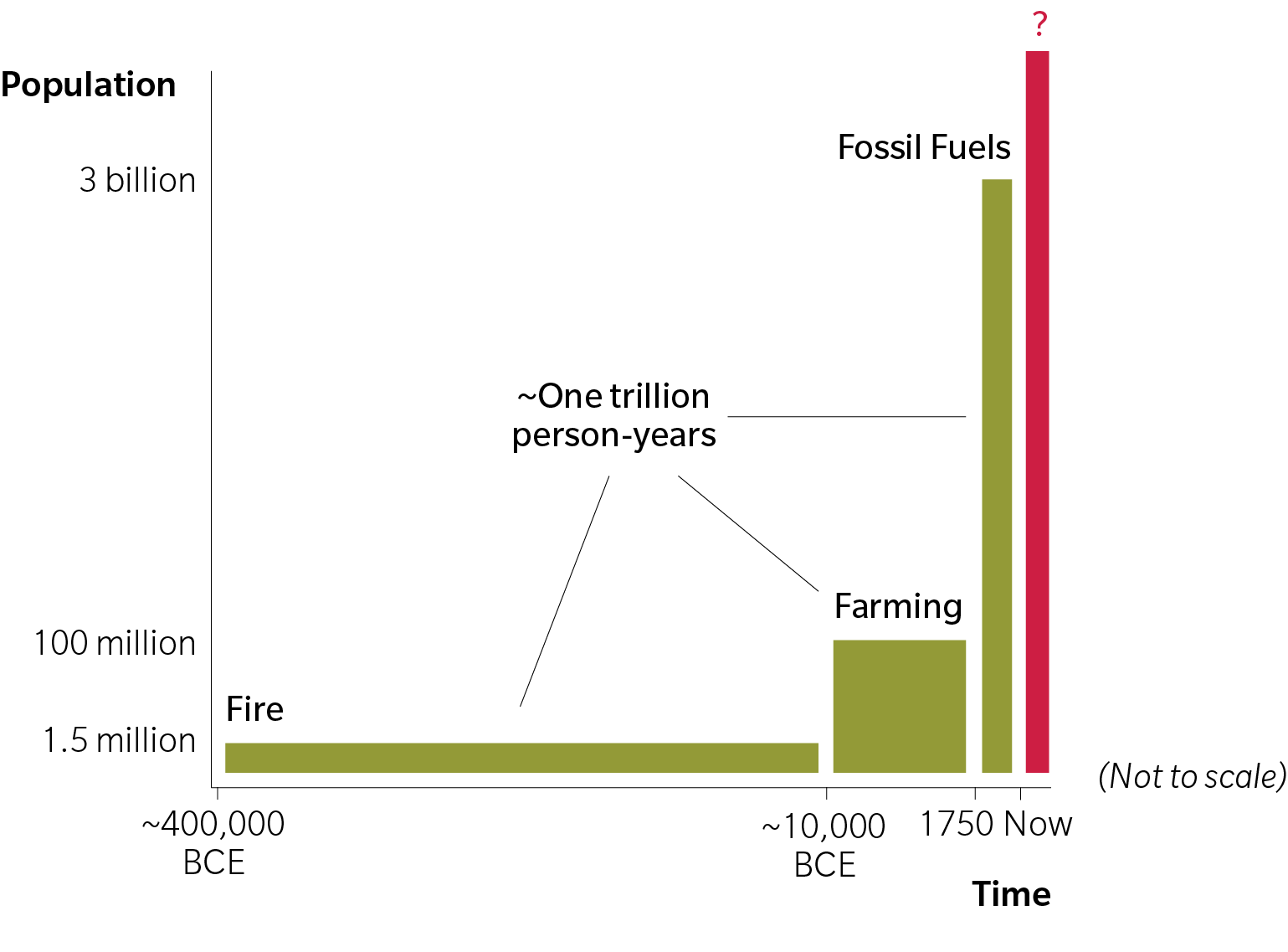
In all of human pre-history and history, we have had three great epochs, defined by three great breakthroughs in our command of energy: fire, farming, and fossil fuels. In time, these lasted, respectively, about 400,000 years, then 12,000 years, then less than 300 years. But each breakthrough unleashed such a jump in our population, that in human presence the three epochs were much the same size: about a trillion person-years.
The figure shows this schematically. (It’s not drawn to scale; if it were, it would be too extreme to see what is going on.)
Today, with the world’s population on track for ten billion people, and life expectancy in rich countries closing in on 100 years, the next trillion-person-years will last just one human lifetime.
This changes the context for how we might think about the next century. It won’t be just one more in a line of some 4,000 centuries of human existence. It will be the fourth great human epoch. This is the red column in the figure.
The danger of thinking on such big scales can be that it makes our own actions feel small. In the spirit of being a ‘good ancestor’ to future generations, The Long Now Foundation strives for a ‘world that operates at the timescale of civilization.’1 The idea is that:
Everyone in this world would find themselves in the middle of the story of civilization.
Everyone in this world would understand themselves as someone else’s ancestor.
Everyone in this world would remember that they are part of something larger than themselves.
To help to normalize this civilizational timescale, the Foundation adds a leading zero to its date formats; we are in the year 02026.
But that leading zero hints at our own insignificance. In the context of the whole of human civilization over tens of thousands of years, how much can it matter what you and I do? By suppressing our sense of agency, a long perspective of many generations gives us ‘a reason for passivity’.2 We can justify whatever we do today, because the causal impact on the long-term future seems tenuous, and we have plenty of time to change course.
For the sake of our planet, some would like us to extend our thinking to even longer time horizons—aligned with geology and not just human civilization. They offer this perspective, for example: if the lifetime of Earth is represented by one yard—the distance from your nose to the end of your finger—then one stroke of a nail file on that finger would erase the whole of human history.3 Shocking, but not empowering.
A shorter outlook emphasizes our agency. But if it’s too short, it can lack a long-term, sustained vision. Then it can provoke a precipitate response and consequent backlash. We are all familiar with the short-termism that comes from 4-5-year parliamentary terms or quarterly financial reporting, each designed to maximize our agency through accountability.
The trillion-person-year epoch resolves the tension. It is a grand epoch on a civilizational scale—the size of one third of humanity’s cumulative existence on Earth to date. And yet it stays within a relatable time horizon, on a human scale. My granddaughter, born this year, may get to live through all of it.
The idea of the ‘Anthropocene’ as a geological epoch was rejected in part because of just this accelerated time horizon: ‘with a span of less than a single human lifetime, it sits uncomfortably within the [Geological Time Scale] where the units span thousands or even millions of years.’4 On a scale of time you can’t equate the Holocene and the Anthropocene; but on a scale of human presence, you can.
By measuring civilizational progress not in time, but in human presence, we see how pivotal this moment is. This accelerated-epoch perspective should both give us perspective and stimulate our sense of agency. We get to make choices now that will shape what a whole epoch becomes.
The great human innovations that introduced the three previous epochs each allowed us to command substantially more energy than before:
Fire let humans use the energy from biomass that they couldn’t otherwise exploit. We were no longer limited to the 60-100 Watts from our own internal metabolism; we could make use of an external energy source, for keeping warm, cooking meat, or clearing ground.
Farming let humans redirect current photosynthesis into our own food, capturing for ourselves a far higher share of the solar energy arriving per hectare.
Fossil fuels let humans release the vast accumulated energy stored in hydrocarbons from past photosynthesis.
With each of these breakthroughs came dramatic changes (even if not immediate) in human prosperity, human population and the planet’s ability to carry it, and also humanity’s impact on the environment.
Those three innovations set a high bar. We may yet meet that challenge, but the rationale for calling a new epoch is different this time. (And it’s not just because it’s a trillion person-years since the last one.) For the first time, the trigger for a new epoch is a need to move on from the old (fossil fuels and other extraction), rather than an opportunity to embrace the new. The three previous epochs were defined by expansiveness; our next one is defined by constraint.
But constraint need not mean worse. In fact, when we had no external constraints, we chose to create them internally in the form of laws and norms, both religious and societal. As Frank Lloyd Wright observed, ‘The human race built most nobly when limitations were greatest and therefore when most was required of imagination in order to build at all.’5
An epoch defined by constraint is not destined to be reductive. It can be as expansive as our previous epochs.
The constraint we face is fundamental: the scale of our collective impact on our planet has become so great that we have to restore and maintain the stability of the Earth system. Eventually that means limiting what we extract from the system, because the Earth’s material resources are finite. More urgently it means limiting what we put into the system, to repair and avoid the damage we have been doing to our soils, oceans, freshwater systems and atmosphere.6
Can such a constraint support a fertile future for humanity? The answer is yes, with a mix of new thinking and new capabilities. Three ideas suggest how.
First is the idea of ‘net zero’. Familiarly applied to greenhouse gas emissions, but applicable more broadly, ‘net zero’ is a target state in which our activities have no net impact on the Earth system. (We take out whatever we put in, and vice versa.) This is an expansive idea, because once you achieve that state, there is no limit to your scale. Twice nothing is nothing. If we achieved 100% collection and recycling of aluminium cans, we could drink from them as often as we liked; we just need to send the same aluminium around the circle of production and recycling more often. That holds for the use of materials; it doesn’t hold for energy, which is consumed every time the material goes around the loop. That is why we need the second idea.
Second is the idea of energy abundance. It has long been observed that you can’t have infinite growth on a finite planet. But when it comes to energy, our planet is not finite; it is constantly replenished. Our concerns about conserving energy are driven by the damaging emissions from burning fossil fuels, not from the energy itself. Mark Lynas, science advisor with the 74-country Climate Vulnerable Forum and head of policy at WePlanet, observes that ‘the availability of clean energy with renewables and nuclear is effectively unlimited… There is no reason why people (or businesses) should not be able to use as much clean energy as they like if they are willing to pay for it.’7
Third is the prospect of a step-change in efficiency. Getting from where we are today to a system of net-zero extraction and pollution and abundant clean energy will involve substantial disruption and up-front cost. So far, it has proved politically hard, bordering on impossible, to persuade societies to accept that disruption and cost, even though the collective returns from doing so are well established. But what if a co-incidental innovation could both jump-start the process of disruption and compensate for the cost, by delivering dramatic efficiency gains? Because, among its many other impacts, AI may be set to do exactly that.
These ideas don’t mean that we will have an expansive future. We are a long way from net zero. The UK (and some other countries) has moved beyond ‘peak stuff’—the economy, despite its growth, consumes less material each year than it did 20 years ago,8 and carbon emissions have halved9—but even the UK is still extracting and emitting, just at a lower rate. These ideas do, however, suggest that we can have an expansive future, if we respond to our constraint as Frank Lloyd Wright would like and expect us to. This is the sort of positive thinking behind Abundance.10 And it is why our sense of agency is so critical.
The point of thinking about the next trillion-person years is not to try to predict the future, and guess what will come after fossil fuels. Rather, it is to engage with the future, in order to influence it. This is an important corrective: we have become over-focused on and over-confident in predicting, and neglectful of our capacity to influence.
It’s not a trivial shift. Our bias towards predicting rather than influencing reflects what we expect of the world. Our experience has taught us that the context will be stable (and so predictable). And, at least in developed countries, we have become increasingly focused on ourselves as individuals rather than society at large. As long as our concern is about how we each better ourselves and our own family, then what’s relevant is to predict the future as best we can, so that we can navigate it; changing the context isn’t a realistic option. Jonathan White, a political scientist, illustrates the trend through the change in political manifestos. Once, these were ‘dramatic statements of principle intended to convey an enticing shared future’, but ‘by the late twentieth century, manifestos looked rather different—more like a shopping list than a statement of principle… A manifesto was conceived as an offer that should have something for everyone, focused on their satiable wants rather than any more general vision of the future.’11
As we transition to a new epoch, the context is no longer stable. Predicting becomes futile and influencing becomes critical. And individualized influencing doesn’t work.
Engaging with the dynamism of a new, accelerated epoch is going to be extremely challenging. In most developed countries, we have become accustomed to a period of unusual stability. That stability has favoured optimization over renewal, openness over resilience, today over tomorrow. This has left us poorly prepared for a more dynamic world. It’s no wonder that we cling to the present, rather than engage with an apparently apocalyptic future.12
Just because we haven’t, doesn’t mean we can’t. But it does mean that we won’t, unless we start to think and act differently. And this is where I hope the combination of impact and agency that is brought out by the idea of the next trillion person-years can contribute. Not to try to dictate the right aspiration for us to have; but to stimulate us to aspire to a fertile future in the first place.
Jonathan White, In the Long Run: The future as a political idea, Profile Books, 2024, p48
Roman Krznaric, The Good Ancestor, WH Allen, 2020, p49
Frank Lloyd Wright, The Future of Architecture, Horizon press, 1953, p55
University of Cambridge Institute for Sustainability Leadership (CISL), Restoring Human Progress: Winning citizens’ support for actions on climate and nature, Cambridge Institute for Sustainability Leadership, 2026, p27. https://zeroideas.org/restoring-human-progress/
Jonathan White, p141
University of Cambridge Institute for Sustainability Leadership (CISL), p33. https://zeroideas.org/restoring-human-progress/